Canada's Arctic Security Problem Analyzed by New Canadians

Sometimes new Canadians see things that we who have lived here all our lives have either never noticed or grown cynical and jaded about.
New to Canada
Anna Antropova and Anastasia Artemova moved to Canada and discovered a gap between what Canada actually was and what people said. I’m not sure who they were listening to, but presumably to the people who convinced them that moving to Canada was a good idea. They set out to explain Canada as a resource for newcomers under the title “Make that Change.” They wanted to inspire to action “everyone who's brave enough to dare.”
Action for what? Listen to the video below for one example. I think they encourage change from what Canada is to that ideal place people talk about. They say on their website in About Us:
[S]omewhere along the way, Canadians who'd been here their whole lives started showing up too, asking the same questions, just from a different angle. So we embarked on a "Decoding Canada" mission for all.
Meet the ladies.

The Arctic Security Problem
In this video, Anna analyzes what I’m going to call the Arctic Security Problem. It was the first task Mark Carney addressed when becoming Prime Minister of Canada. He picked up former Prime Minister Justin Trudeau’s project to buy over the horizon radar from Australia. SOURCES: US and Canada to Step up Arctic Capabilities with Over-the-Horizon Radar and Facilities for F35, March 27 2023; Carney announces Canada will partner with Australia on Arctic over-the-horizon radar system | FULL, March 18 2025; Australia, Canada Sign $2.5 Billion Arctic Radar Deal as Ottawa Accelerates NORAD Modernization, June 23 2026.
Carney’s Announcement for Transforming the North, March 12 2026
Canada is also undertaking other attempts to secure its Arctic. On March 12 2026, Prime Minister Carney announce[d] ambitious new plan to defend, build, and transform the North | Prime Minister of Canada. QUOTE:
The assumptions that shaped decades of Canadian defence and security are being upended. Climate change is causing our Arctic region to warm nearly three times faster than the global average, a shift that great powers are actively looking to exploit.
For decades, previous Canadian governments have taken measures to build and secure the North. But these lacked the scale and the breadth of strategy that this vast region demands.
With this new plan, Canada is taking full responsibility for defending our Arctic sovereignty.
Build/expand/upgrade hydro, internet, roads, ports, airports in Yellowknife, Inuvik, Iqaluit, Rankin Inlet, 5 Wing Goose Bay, Grays Bay, Mackenzie Valley
four new Northern Operational Support Hubs/Nodes at Whitehorse, Resolute, Cambridge Bay and Rankin Inlet.
Canada cannot rely on another country for our security and prosperity. By working in partnership with Territories and Indigenous partners to build out the full potential of a united, connected Northern region, we can give ourselves more than any one nation can take away. With this ambitious new plan, Canada is taking control of its future and building a stronger, more independent country.
See also Prime Minister Carney secures new defence partnerships at the 2026 NATO Summit | Prime Minister of Canada, July 8 2026.
All of these articles explain very clearly that there’s a security problem in the Arctic and that it’s serious because the Arctic is melting very fast. But no one explains the international problem like Anna does, the real threat, and how it impacts Canadians living a thousand miles away. If they can take away this line up here in the Arctic, Anna asks, of what value is this line down here on the 49th parallel? I remind all Canadians of the blood shed not only in the War of 1812 but in the many other skirmishes before and since to establish the thousand miles of international border east of Lake of the Woods, especially between Detroit/Windsor and the Atlantic Coast.
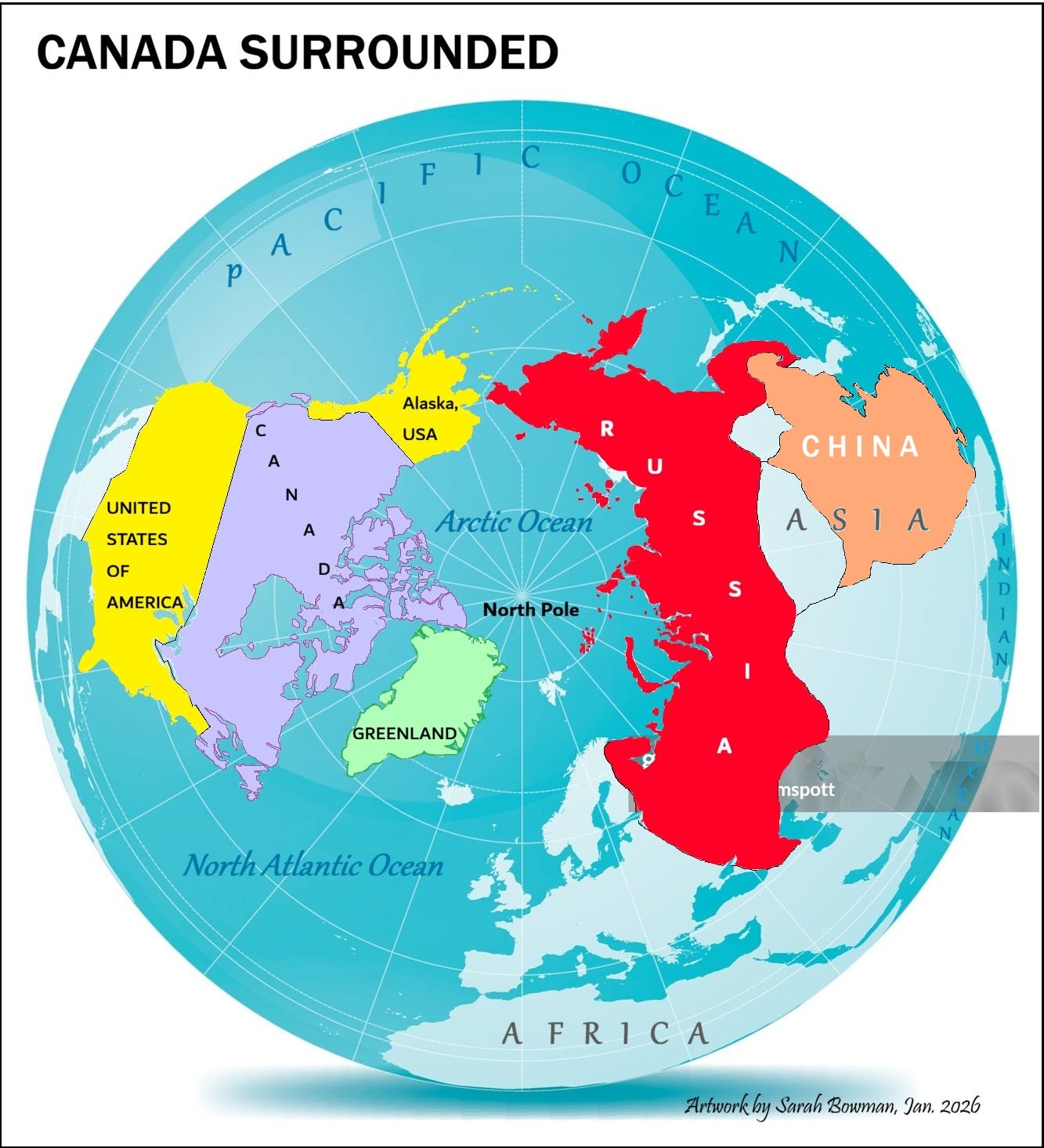
The price of Canada’s sovereignty has been high. It is up to our generation to protect it at any price, from sea to sea to sea, from the Great Lakes and 49th Parallel to the northern tip of Elsmere Island. Canada is the purple country on this map. Never before looking at this map with the yellow fingers of US coastline snaking up and down our east and west sides did I realize how boxed-in we are. Now Trump’s company has moved into Greenland without permission.
THE REAL THREAT
Why Canada Can’t Defend Its Own Arctic, July 23 2026
DIPLOMATIC INSULT
Anna speaking, Min. 0:00:
In August 1985, an American icebreaker pointed its bow into the Northwest Passage, waters Canada had spent over a century treating as its own. Ottawa hadn’t been asked. It hadn’t even been consulted, just told after the fact, “We’re coming through.” And Canada let it happen. Because at that moment, we had no ship close enough and no legal case strong enough to stop it.
0:24 So for a few days in 1985, the answer to who controls this water came down to who happened to be there and who didn’t. Forty years later, we’re spending over $40 billion to defend the Arctic. And every headline tells us who the threat is.
0:40 Russian combat ice breakers, Chinese research vessels probing our approaches.
0:44 Real concerns, and we’ll get to both. But there are four countries making serious moves in the Arctic right now. And only one of them has already shown that it can walk through our claim and face no consequence. So before we go any further, pick your answer. Russia, China, the United States, or us, Canada. Which one is the real challenge to Canada’s Arctic?
China=Near-Arctic State vs US=Arctic Nation
Anna speaking, Min. 1:10:
China is just geographically a near Arctic state. The United States is an Arctic nation. These restrictions cannot stop us from this process, from exploring the Arctic.
TWO WORLDS: Internal Waters vs International Waters
Anna speaking, Min. 1:28:
Here is what made that 1985 voyage more than a diplomatic insult. When the ship’s bow cut into those channels, it was testing which of two worlds we live in. In one world, the channels between our Arctic islands belong to Canada—our water, our rules, and nobody enters without asking.
1:48 In the other world, those exact same channels are just a corridor between two oceans, open to any nation, ships, be freighters, research vessels, or warships. No permission required. Lawyers have names for those two worlds:
internal waters versus
international waters.
2:05 Which is why within weeks of that 1985 voyage, Ottawa did something that it had put off for decades. It drew official baselines around the entire archipelago and declared everything inside them including the northwest passage historic internal waters.
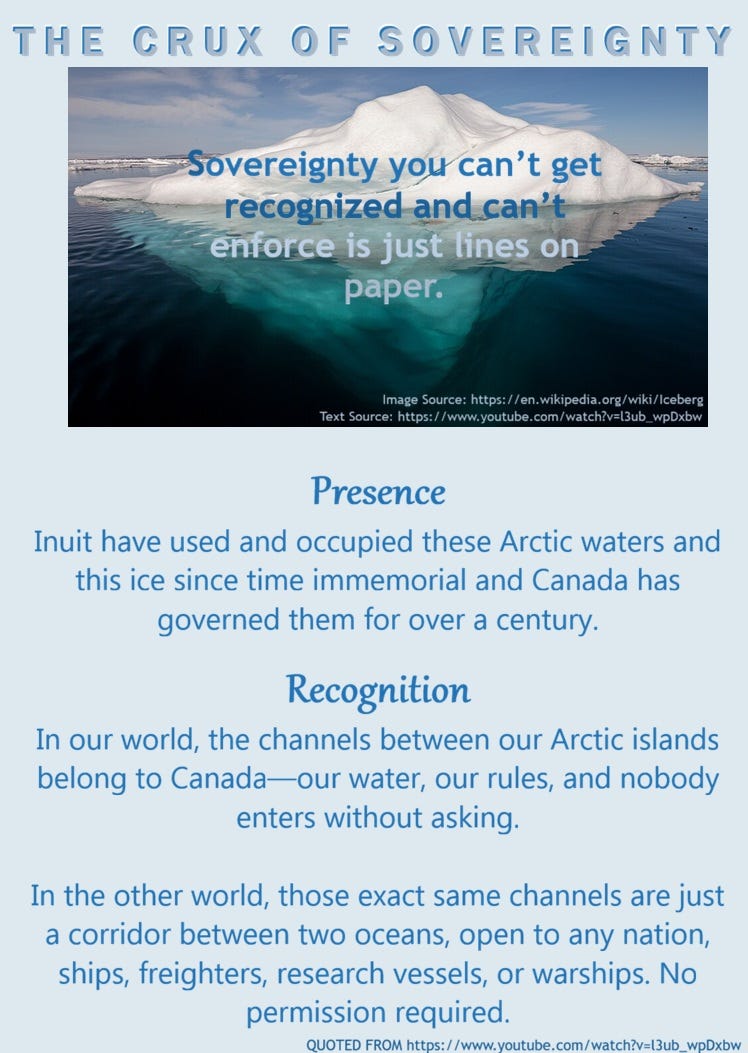
2:21 Our claim rests on something older than the country itself. Inuit have used and occupied these waters and this ice since time immemorial and Canada has governed them for over a century. There is a teeny tiny problem here though. A claim like ours has one structural weakness. It needs other countries to accept it.
Anna speaking, Min. 2:43:
Sovereignty you can’t get recognized and can’t enforce is just lines on paper. And that is the first thing that we need to come to terms with. The Arctic game isn’t one with ships alone. It’s one with recognition [and] presence. …We have four players who want access to [the Arctic]. Four countries for whom recognition and presence in the region means different things.
The Four Countries
Russia
Anna speaking, Min. 4:39:
And the first country everyone thinks of is obvious, Russia. Russia’s goal is simple. Turn its own Arctic coastline into the toll road of the century. The northern sea route runs along Russia’s northern coast, a shortcut between Europe and Asia that Moscow controls end to end. In 2025, transit shipments on it reached about 3.2 million tons with container volumes up 160% in a single year. To protect that route, Russia has been rebuilding Soviet Arctic bases.
5:15 The effort Moscow is making to upgrade its Arctic bases is massive and modernizing the largest icebreaker fleet on Earth. More than 40 ice breakers and seven of them nuclear-powered. And in September 2025, it commissioned something new, the Ivan Papan, an armed petrol icebreaker.
5:34 Western analysts immediately nicknamed the combat icebreaker. That’s the Russia you’ve seen in every headline. Russia is flexing its muscles again. and the Canadian Navy is right in the middle of it.
5:45 Now, there is one thing that most headlines skip. Russia has never claimed a single meter of our Arctic. Its entire buildup, the bases, the fleet, the missiles sits on its own side of the Arctic Ocean, protecting its own route. Moscow and Ottawa actually have one thing in common here.
6:17 Russia claims that northern sea route runs through its internal waters using arguments that rhyme with ours about the Northwest Passage. That means that if Russia ever tried to undermine our claim, it would be handing the rest of the world a manual for undermining its own claims.
6:33 So, oddly enough, for entirely selfish reasons, Russia is kind of in our corner on this one. This doesn’t make Russia harmless, though. A militarized Arctic neighbor raises the stakes for everyone, and Russian bombers and submarines are exactly why NORAD exists. But being dangerous in general is not the same as challenging Canadian sovereignty in particular.
6:55 So if the country with the biggest fleet and the loudest headlines isn’t actually disputing our map, then who is?
China
Anna speaking, Min. 7:05:
Through the summer of 2025, American Coast Guard crews of Alaska kept doing something that used to be rare.
7:11 Four Chinese military ships spotted near Alaska.
7:14 It says it detected, tracked, and intercepted multiple aircraft.
7:18 US military has sent four of its naval destroyers to Alaska. Eleven warship joint naval task force between Russia and China hailing Chinese ships to ask what they were doing there. They kept seeing research vessels operating legally in international waters.
7:44 Mapping seabed in numbers nobody had seen before. That’s perfectly permissible but also strategically calculated. Every survey builds data and every uneventful season tests how close you can get before anyone reacts. Those shapes are the visible edge of a bet China placed years ago when it gave itself a title that exists nowhere in international law. They called themselves a near Arctic state.
8:10 China’s words and actions raised doubts about its intentions. Beijing claims to be a near Arctic state. Yet, the shortest distance between China and the Arctic is 900 miles. China’s nearest territory sits roughly 1,500 km from the Arctic Circle, so it’s not quite near the Arctic, but that statement does a good job at announcing an intention.
8:31 China plans to be present in the Arctic without owning any of it. Now, the capability behind those research vessels is growing fast. China’s icebreaker, the Schwa Yong or Snow Dragon, has arrived in the North Pacific Ocean.
8:46 The GD, China’s newest polar research icebreaker, went from contract to launch in just over 2 years. Two years to build a massive ship. That’s a pace Western shipyards can’t currently match.
8:59 So, how does Beijing treat our waters specifically? Carefully is the most accurate word to describe it. China has never recognized Canada’s claim to the Northwest Passage, but it has never formally challenged it either. It stays deliberately ambiguous by talking about freedom of navigation and keeps every option open.
9:21 At this point, you’re surely seeing the pattern, right? Two so-called threats, and both of them seem harmless. One is busy fortifying its own coast, and the other is hedging.
Naming the 1985 US Interloper
Anna speaking, Min. 9:32:
It’s time to reveal who that ship from 1985 was. The one that didn’t stop at the line. It’s time to name it.
9:42 The icebreaker that sailed through the Northwest Passage in August 1985 without asking Canada’s permission was the Polar Sea, a United States Coast Guard ship.
9:52 And it wasn’t the first. In 1969, the American oil tanker Manhattan pushed through the passage the same way. Both times Canada scrambled to save face. In 1985, we granted a permission nobody had requested and put Canadian observers on board. In 1988, both countries signed an agreement. The US would now ask if their ice breakers can come through and Canada would say yes.
10:16 But if we read the fine print, we’ll see that the agreement preserved each side’s legal position. And for the US, that position is that the United States does not recognize the Northwest Passage as Canadian. And to this day, this is the case. Not under Reagan, not under Obama. In fact, his administration reaffirmed in official policy that the passage is a straight use for international navigation.
10:44 In 2019, Secretary of State Mike Pompeo stood at an Arctic Council meeting and called Canada’s claim outright illegitimate. Out loud, in public, in front of our diplomats. And for decades, that disagreement was manageable. Awkward, but still manageable. Just a tiny footnote between friends who tended to agree on everything that mattered.
11:05 But then that friendship changed. In April 2025, the White House signed an executive order titled Restoring America’s Maritime Dominance, directing the Secretary of Defense to develop a strategy to their wars. Secure Arctic waterways. In February 2026, the resulting Maritime Action plan declared investments in icebreaker fleets and high latitude operations to do exactly that.
11:33 Layer on top of that, the repeated talk of acquiring Greenland.
CANADA’S BIG PROBLEM
CLIP Woman speaking, Min. 11:37:
Trump wants to buy Greenland.
CLIP Trump speaking, Min. 11:38:
It’s a large real estate deal. So, the concept came up and I said certainly I’d be strategically it’s interesting.
If US Anchored Both Ends of Northwest Passage…
Anna speaking, Min. 11:45:
And the 51st state rhetoric aimed at us and the old legal footnotes starts reading very differently. If the US anchored Greenland, it would hold both entrances to the Northwest Passage. Former Canadian national security officials are now openly discussing scenarios where an American warship transits our Arctic without asking, precisely because nothing in international law, as Washington read it, would stop them.
12:10 I want to be precise here. This is not a video about the US being the enemy. It isn’t one. Our continental defense runs through NORAD together. But here is what stood out while pulling the research together.
12:24 I kept expecting the American position to soften at least somewhere. But it doesn’t get softer. Our security partner is our legal adversary. Both things are true at once.

Anna speaking, Min. 12:35:
And that contradiction is exactly what Canada has to solve. What is Canada protecting exactly? Not the land. Nobody disputes that the islands themselves are Canadians’. It’s the water between them.
12:50 Forty percent of our land mass sits inside the Arctic and 3/4 of our coastline traces through it. Which means the channels threading through that archipelago aren’t a tiny deal. They are the majority of the Canadian coastline. If we lose the argument over those channels, we lose the biggest stretch of water we have. And remember the statement that we made in the beginning, claims are won with recognition.
13:15 And the best way recognition is earned is by presence. For decades, our presence was thin. Patrols here and there, resupply emissions, empty promises. But in March 2026, things have changed.
Note my comments above under the heading “Carney’s Announcement for Transforming the North, March 12 2026.”
Making Carney’s Plan Real
Anna speaking, Min. 13:30:
The plan Ottawa announced commits over $40 billion to the North. Three pieces matter the most for this story. First, $32 billion will go towards so-called Forward Operating locations in Yellow Knife, Inovic, and Iqaluit, plus the base at Goose Bay. Think of them less as bases and more as northern jump points, places where fighter jets, surveillance aircraft, and troops can launch from or refuel at instead of lying the entire mission.
13:56 Second, $6.5 billion will be invested in an over the horizon radar system built in partnership with Australia. Over the horizon means exactly what it sounds like. Rather that sees past the curvature of the Earth, watching the approaches to the continent thousands of kilometers out.
14:15 Third, and this is the piece I find the most interesting, Grays Bay, a 230 km all-season road from the Nunavut border to a deep water port on the Arctic Ocean. It would be Canada’s first overland connection to Arctic tide water in our history. Now that’s presence. That’s the kind of presence that we can drive on. The one we can use to move critical minerals to south and military equipment north.
14:43 Now there is one piece of Canada’s Arctic strategy I have to draw our attention to because on paper it looks like cooperation, but underneath it might just be the opposite. In November 2024, Canada, Finland, and the United States signed an agreement to jointly build ice breakers.
Point of interest. That must be what Trump was talking about on January 7 2025, though he got it all muddled. I know from personal experience how Alzheimer’s patients’ declining brains cling to word association to make sentences. The Canada-United States-Finland signing of the Ice Breaker Collaboration Effort (ICE Pact) on November 13 2024 happened a week after Trump was elected. Then-Canadian Prime Minister Justin Trudeau announced his resignation on January 6 2025, the day before Trump is speaking. Possibly he only found out and all these things are percolating in his brain.
Trump calls PM “governor Trudeau” - reiterates that Canada “should be a state”, Jan. 7 2025
Trump speaking, Min. 0:00:
I said to, as I called him, Governor Trudeau, I said, “Listen what would happen if we didn’t subsidize you,” because we give them a lot of money. We help them, as an example we’re buying ice breakers and Canada wants to join us in the buying of ice breakers. I said, “You know, we don’t really want to have a partner in the buying of ice breakers. We don’t need a partner…”
So yeah, the United States is buying ice breakers but Donald Trump didn’t get the details. He thinks the US is subsidizing Canada big time and so he doesn’t want to share the purchase with Justin Trudeau.
Anna speaking, Min. 15:02:
It makes industrial sense. Canada’s Davie Shipyard owns Helsinki shipyard, which has built about half the world’s ice breakers. In October 2025, Washington ordered up to four Finnish-built ice breakers for $6.1 billion and authorized four more Arctic security cutters and they have the first one arriving in the next 2 to 3 years. And now look at both things at once.
15:25 We are helping our closest ally build ice breakers and our closest ally has never recognized our Arctic waters. We may be constructing the very ships that one day will transit through our Northwest Passage without asking.
15:40 At this point, any rational person would ask, “Why would we agree to this? And is there an alternative?
15:47 Walking away isn’t really an option. If we refuse to help build American ice breakers, the US still doesn’t recognize our claim. We’ve just lost our partner while Russia keeps adding ships. So, Canada is betting on a different approach. Build presence together now and let that presence make progress that arguments never made. And whether that bet pays off, we will find out in the next decade.
The Impact on Canadian Lives
Anna speaking, Min. 16:14:
Let’s bring this home because 162,000 km of coastline feels abstract until we feel what influence it has on our lives. If you work in construction, trades, or mining, the north is about to become one of the largest job sites in the country. Since not everyone wants to work in the Arctic, the labor shortage in the territories is real and the wages reflect that.
16:36 If you invest, the entire Grays Bay corridor exists to connect critical mineral deposits to global markets. The copper, zinc, and rare earth minerals that every energy transition scenario depends on. Canadian miners with assets along the corridors are sitting on deposits that were largely stranded until a road existed.
16:56 This isn’t a financial advice on what to buy. It is just a map of where the infrastructure money is going. And infrastructure money tends to arrive before the market fully prices it.
17:07 And for all taxpayers, the $40 billion comes from our pockets. And that’s effectively the pricing of Canada’s infrastructure in the north. We’re trying to buy recognition of a claim we can’t afford to lose.

Anna speaking, Min. 17:21:
Because if the passage is ever reclassified as an international strait, we don’t set the environmental rules. We don’t control the traffic and we don’t collect a dollar from whatever moves through it. And if you live anywhere in southern Canada, the precedent is the stake. A border that can be reinterpreted in the north is a border that can be reinterpreted. Full stop.
This is what I was referring to in my opening re the War of 1812. If one line is nothing, then another line is nothing and all that blood was shed for nothing. We CANNOT let this happen, no matter where we live in this vast landmass that is Canada.
For “precedent is at stake,” Google tells me:
When a legal precedent is the stake, the primary issue is that a single court case carries deep consequences for future rulings. The outcome will set a rule that binds or guides all similar future disputes, making the broader legal principle far more important than the immediate dispute itself (Precedent - Wikipedia).
Very scary.
Anna speaking, Min. 17:44:
We opened this video with a question and you picked an answer. Russia, China, United States or Canada. And here is the verdict that evidence supports.
17:53 Russia is dangerous on its own coast. China is patient on everyone’s coast. But the only player that has spent 70 years refusing to recognize our Arctic through every administration in official policy out loud is the one we built our continental defense with. The player to watch was never the one building bases across the pole. It is the one that never signed off on a map borders.
18:18 And yet, the most important move on the board is ours. Recognition is earned by presence. And for the first time in history, we are building presence you can land a plane on, dock a ship at, and drive a truck over. There’s one more layer to the story that we didn’t even touch today.
18:34 There are 140,000 people who live in the Arctic, and Canada’s entire legal claim quietly rests on them. Let me know in the comments if you want us to expand on that in the future videos because this topic deserves a separate conversation.
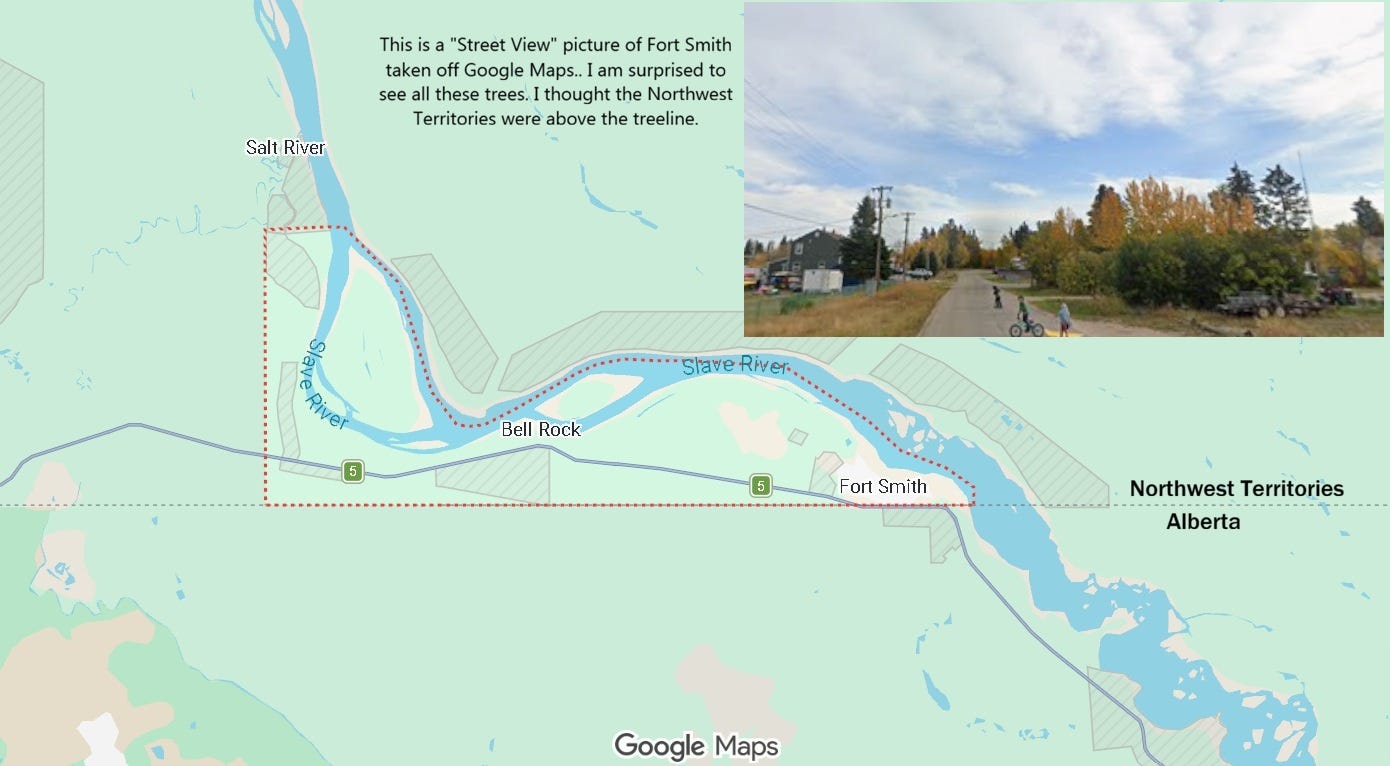
For me, this was definitely worth a listen. Fresh eyes see things that lifelong Canadians can miss for being too familiar with it all. But I think Mark Carney saw it. He did, after all, do part of his growing up in the North. He still identifies with Fort Smith, NWT.